


Crafty AF
The Architecture of Everything
Wholeness
Quotes from; The Battle of the Life and Beauty of the Earth
"If each of us is to engage in the very personal journey toward wholeness, and thereby heal our communities (the only way community can be healed at all), we must keep wholeness at the forefront of our thinking and our activities. We seek to create coherence in the physical realm, the spiritual realm, the emotional realm; and perhaps, above all, in the realm of art - that spiritual realm of art and creation, where we are able to find unity."

What is
Wholeness
"How do we make intellectual sense of the enigmatic word 'wholeness' which is the opposite of wasteland? It promises so much, yet falls so far short in precise scientific meaning, that one almost throws up one's hands."
"Wholeness speaks of the oneness of all things. It suggests a vast understanding of things in their entirety. It speaks to us, encouraging us to try and see things in their unity, perhaps unity with god; certainly in their ecological health (potentially a scientific concept, but one that has not been clearly defined); and certainly in some sort of social communication and coherence."
First, wholeness is a Structure, and can be understood as such.
"This means that when we try to find the wholeness of a particular thing or place, we can point a finger to that structure."

Second, the thing we call Wholeness always extends beyond the thing in question.
"It is not possible to be whole by being isolated by all that surrounds you."

Third, there is the fact that somehow, any Wholeness we want to point to, or think about, seems to elude comprehension.
"That is why I sometimes call it "Wholeness, the intangible," The intangible comes from the fact that everything that has, or maintains wholeness, is always unique. This means that words and concepts almost always fail to encompass it perfectly; only the wholeness itself can point to what it is."


Fourth, there is, too, the presence of unity.
"What we refer to as wholeness, is a quality of being one, being glued-together, interlaced, being unified. It is, also, somehow at peace."
Wholeness can only be achieved in the act of grasping it and moving into it, creating it and experiencing it.


Fifth, each Wholeness contains and is composed of myriad other wholes.
"This last is something that is describable. There are specific geometric qualities and properties that come into play. They are always there, and must be there, in order to create the wholeness of the larger thing."
Sixth and finally, the idea of Wholeness encompasses the idea of healing. When something is whole, we consider it healed.
"If we wish to heal something, we seek to make it whole. The Middle-English word Hale, lying as it does halfway between whole and heal, gives us a sense of this connection."
"When a group of people make their environment for themselves, this has enormous healing consequences... but when people are "given" an environment built by others, whether out of commercial interest, or from patronizing motives that attempt to do good, then it effectively means that the environment is getting built for quite different motives."
Quote Switch
Sudden I know, but I will be quoting excerpts from a different source now; still Christopher Alexander but this time from his book "The Nature of Order: Book 1" The topic is the same but with a broader application than previously.
And of course the images of my miscellaneous craft projects continue.


"Our world is dominated by the order we create."
"But although we are responsible for the creation of order on this enormous scale, we hardly even know what the word order means. Our present idea of "order" is obsolete... if we are honest we must admit we hardly know what kind of phenomenon it is. Yet we build this world, producing its order, day by day. Thus we go on, willy-nilly creating order in the world, without knowing what it is, why we are doing it, what its significance might be."

"Our modern picture of the Universe,"
"...what kind of stuff space and matter is made of, has not been influenced by building or by architecture. Yet I shall argue, the process of building is an order-creating process of no less importance than those of physics and biology. It is vast in its scale and scope. It is almost universal in our experience. It is therefore reasonable to think that the art of building might give us equally essential insights.

Consider
"Making buildings at the level of beauty which was common in the 12th or 13th Century Europe and in hundreds of other cultures in almost all eras of human history except our own is very hard for us. It was especially hard for us in the late 20th Century, and will continue to be as we enter the 21st."
"For some reason - not at first entirely clear to me 35 years ago - it is a matter of such difficulty for us that architects have almost given up. But I have not been willing to do so."
"I never agreed to put up with second best, or to accept the almost silly idea of "good architecture" which certain 20th Century architects have foisted on the public."

Knight of
Shrubs
Middle Arcana

"I wanted to be able to do the real thing,"
"And for that I had to know what the real thing is. The reason was not intellectual curiosity - but only the practical reason that I wanted to be able to do it myself."
"Thinking about these matters has been exceedingly difficult. It has taken me 35 years to think my way out of the intellectual thicket where I started. And I believe that this intellectual confusion is shared today by almost every architect."

"I am at heart a very empirical person."
"I try to think carefully about things, and I want them to make sense. Again and again I found that there were issues in the making of buildings where our modern mentality - our way of looking at the world - makes it hard, or impossible, to come to grips with the facts as they are."

Yes..
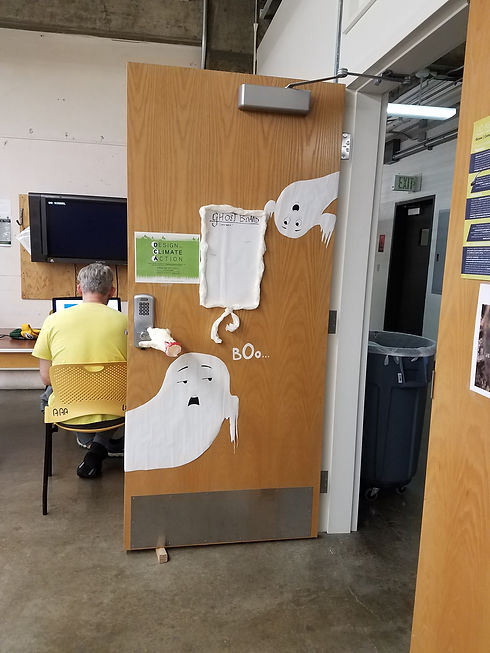
It was Halloween
"Even now,"
"...on some days I look at the theory I have formulated in these four books and can hardly believe that it is true. It provides a view of the universe that is so surprising, and so much at odds with the normal common-sense ways of thinking about physical reality we have currently, that it seems almost like a fantasy, like some kind of fiction."
Process
"My colleagues and I made observations, looked to see what worked, studied it, tried to distill out the essentials, and wrote them down. But we did do one thing differently. We assumed from the beginning that everything was based on the real nature of human feeling and - this is the unusual part - that human feeling is mostly the same, mostly the same from person to person, mostly the same in every person."

Even Food
"Of course there is that part of human feeling where we are all different. Each of us has our own idiosyncrasies, our unique individual human character. That is the part people most often concentrate on when they are talking about feelings, and comparing feelings."
"But that idiosyncratic part is really only about ten percent of the feelings which we feel. Ninety percent of our feelings is stuff in which we are all the same and we feel the same things. So from the beginning, when we made the pattern language, we concentrated on that fact, and concentrated on that part of human experience and feeling where we all feel the same."
"That is what the Pattern Language is - a record of the stuff in us, which belongs to the ninety percent of our feeling, where our feelings are all the same."

"In the 20th Century we have passed through a unique period,"
"...one in which architecture as a discipline has been in a state that is almost unimaginably bad. Sometimes I think of it as a mass psychosis of unprecedented dimension, in which the people of earth - in large numbers and in almost all contemporary societies - have created a form of architecture which is against life, insane, image-ridden, hollow."
Much of this construction is caused by developers, housing authorities, owners of hotels, motels, airport authorities. In that sense architects might be considered blameless, since in some degree the ugliness of what has been created is caused by new relations between time, money, labor, and materials and by a set of conditions in which the real thing - authentic architecture that has deep feeling and true worth - is almost impossible.
"But Architects are not blameless."
"For the most part, architects have stood by, content to play their role as part of the 20th-century machine. In many cases they make it worse. They gild the lily of commercial development with pretentiousness. Many architects have raised the designer-conscious fashion of building to new levels, have invented absurd ways of thinking about architecture, have altogether poisoned the earth with an abundance of terrible and senseless designs which have few redeeming features."
"Of course architects, like others, have a conscience. Many of us regret the situation. Many struggle, like drowning men and women, in the sea that engulfs us. Some of us, though, do not know what to do. We must eat, we cannot afford to lose our jobs. The conditions which create the inhumane architecture that is being produced cannot be too closely scrutinized, since too close a scrutiny can lead to uncomfortable questions, which may make us unemployable.
"I do not think architects are happy with all of this, any more than other members of society are happy."
The Universe
"Very few people realize, I think, how much the present confusion which exists in the field of architecture is wound up with our perception of the universe. I have come to believe that architecture is so agonizingly disturbed because we - the architects of our time - are struggling with a conception of the world, a world-picture, that essentially makes it impossible to make buildings well. I believe this problem goes so deep that it even makes it extremely difficult to build the most modest, useful building in an ordinary way."


"And if we do..."
"...if we do ever examine our own picture of the world, we shall find, no doubt, a rather complicated mixture of things: vague conceptions of atoms, galaxies, and stars; organic life as it appears on earth from, we are told, some primordial soup of amino acids. Mixed with this, there is no doubt some form of concern for our fellow human beings, some kind of piety, some awareness that certain things are more beautiful and others less. How can all this muddles mess of a conception of the world be responsible for anything?"

"How could it possibly be true..."
"...that this conception might interfere so deeply with our efforts as builders, that is makes it all but impossible to make a building well??
"The implication seems fantastic. And yet this is just what I believe. I believe that we have in us a residue of a world-picture which is essentially mechanical in nature - what we might call the mechanist-rationalist world picture."

Good Good

"Whether or not we believe..."
"...that we are subscribing to this picture, whether or not we are aware of the impact of its residue in us, even when we consider ourselves moved by spiritual or ecological concerns, most of us are still - I believe - to a greater of lesser extent in the grip of some residue of this mechanical world-picture."
What is Order?
"We know that everything in the world around us is governed by an immense orderliness. We experience order every time we take a walk. The grass, the sky, the leaves on the trees, the flowing water in the river, the windows in the houses along the street - all of it is immensely orderly. It is this order which makes us gasp when we take our walk. It is the changing arrangement of the sky, the clouds, the flowers, leaves, the faces around us, the dazzling geometrical coherence, together with its meaning in our minds."
"But this geometry which means so much, which makes us feel the presence of order so clearly - we do not have a language for it."


To create Order
"And what should we do to create order? Even the smallest building has order of great complexity. In the course of laying out and making the volume of the building, the filigree of structure, floors, windows, doors, and ornament - we face a dazzling task. What is the order we should infuse it with?"

"In large projects, especially,"
"...we can get easily muddled. More is at stake, so the nature of order we put in is especially crucial. We rely more on intellectual conceptions. So then our conceptions about order begin to enter in explicitly. It is not a single brick, or door, or roof. It might be a whole neighborhood - millions of dollars of construction - perhaps the living environment for hundreds of people at a time."
"How do I do this? What kind of order should it embody, to make sure it is a success?"
Order: Meaning?
"What exactly do I mean by order?"
"In a sense, everyone knows what order is. But when I really ask myself "what is order" - in the deep sense of geometric reality, deep enough so I can use it, and so that it is able to help me create life in a building - then it turns out that this "order" is very difficult to define."


Some Attempts
"Scientists have been trying to define order for about a century."
"Deeper theories of order have been attempted." ... "Perhaps one of the clearest statements so far has been expressed by the physicist David Bohm. Bohm tried to outline a possible theory in which order types of many levels exist and are built out of hierarchies of progressively more complex order types."
"But none of this, suggestive as it all is, is directly useful to a builder. Even the most advanced of these ides is still not deep enough or concrete enough to give us practical help with architecture, where we actually try to create order every day. If I want to create a building as beautiful as the yellow tower [a yellow tower from the Hunan province in China is shown for the reader in the book], these theories of order are not even remotely deep enough to help me in a practical fashion."

Mechanism

Beyond Mechanical
"So in the present scientific world-picture, the order which we see in the thing, the way we describe it to ourselves, is essentially the order of a machine which has a certain mechanical mode of operation - or which, at any rate, has a certain kind of mechanical behaviour as a result of the arrangement of its parts."

"But what of order itself? The order itself - that order which exists in a leaf, in the Ise shrine, in the yellow tower, or in a Mozart symphony, or in a beautiful tea bowl - a harmonious coherence which fills us and touches us - this order cannot be represented as a mechanism."
"Yet it is this harmony, this aspect of order, which impresses us and moves us when we see it in the world."

"If, as an artist, I want to understand the yellow tower - if I want to make something of comparable beauty - it is useless to conceive of it as a mechanism, because the beauty and order which I see in it, and yearn for, cannot be expressed in any way that can be understood mechanically"
"So, in works of art, the mechanistic view of order always makes us miss the essential thing."

"The mechanistic idea tells us very little about the deep order we feel intuitively to be in the world. Yet it is just this deep order which is our main concern."
"The real nature of this deep order hinges on a simple and fundamental question: "What kinds of statements do we recognize as being true or false?" This is the question which divides the mechanistic world-view originating with Descartes from the one which I describe in this book."
